our communities for a Brighter Future

Zed Kaʻapana Aki envisions a stronger, more self-sufficient District 6—where rural communities are prioritized, local families can afford to thrive, and development is guided by responsibility, balance, and respect for our ʻāina and community character. He is committed to tackling the real challenges our district faces with transparent leadership, community-driven decision-making, and solutions that protect our rich past and the quality of life that we hold onto today, while securing opportunities for generations to come.

District 6 Through Community-Driven Solutions

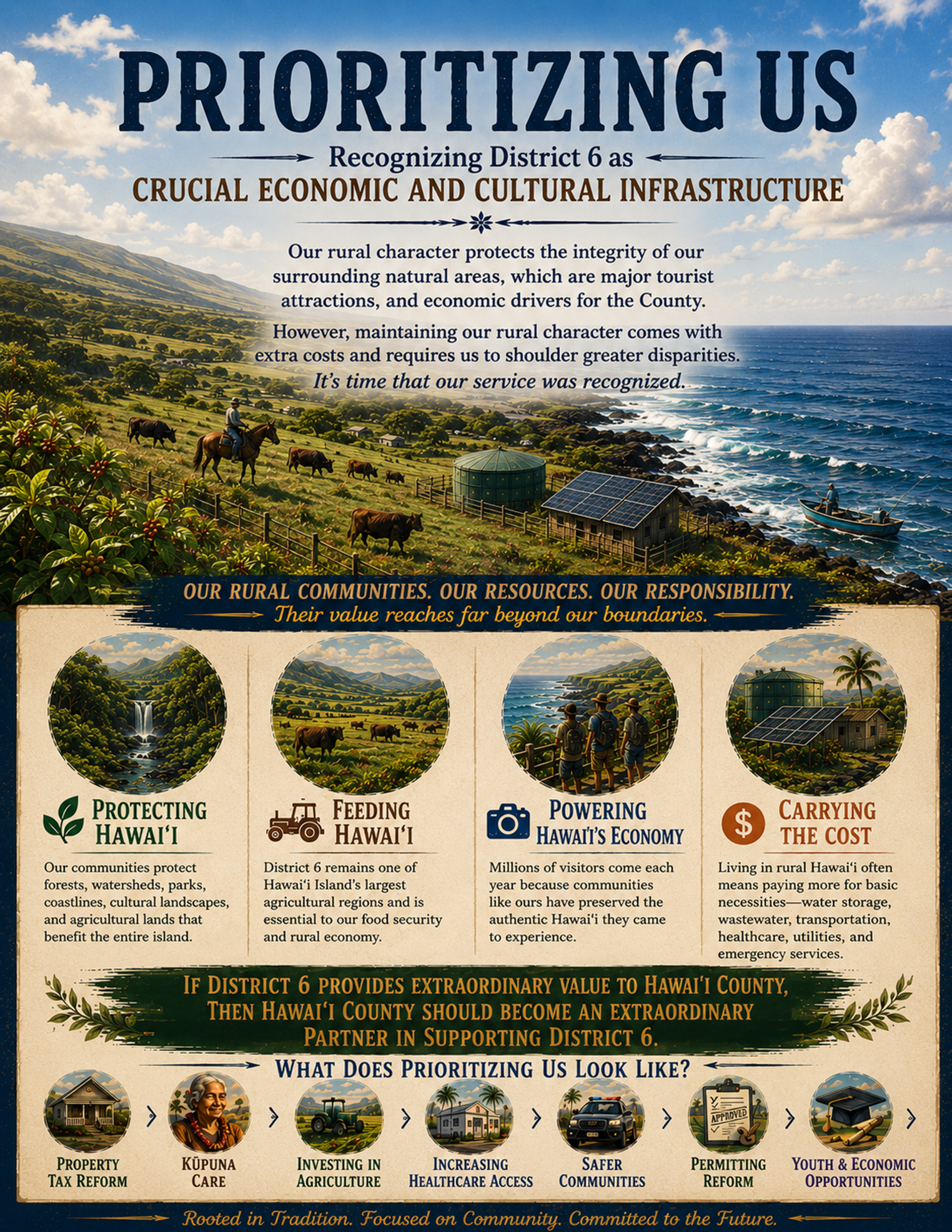
District 6 is one of the most diverse and powerful districts on Hawaiʻi Island—stretching across Kaʻū, South Kona, and some of the most rural communities in the state. But for too long, our people have carried the burdens of distance, limited services, high costs, and uneven investment.

Zed Kaʻapana Aki believes District 6 should no longer be treated as an afterthought. With the right leadership, we can turn our rural challenges into rural strengths—and build a district that is healthier, more self-sufficient, and more resilient for generations to come.

Rural Resilience: Healthcare & Kūpuna Care
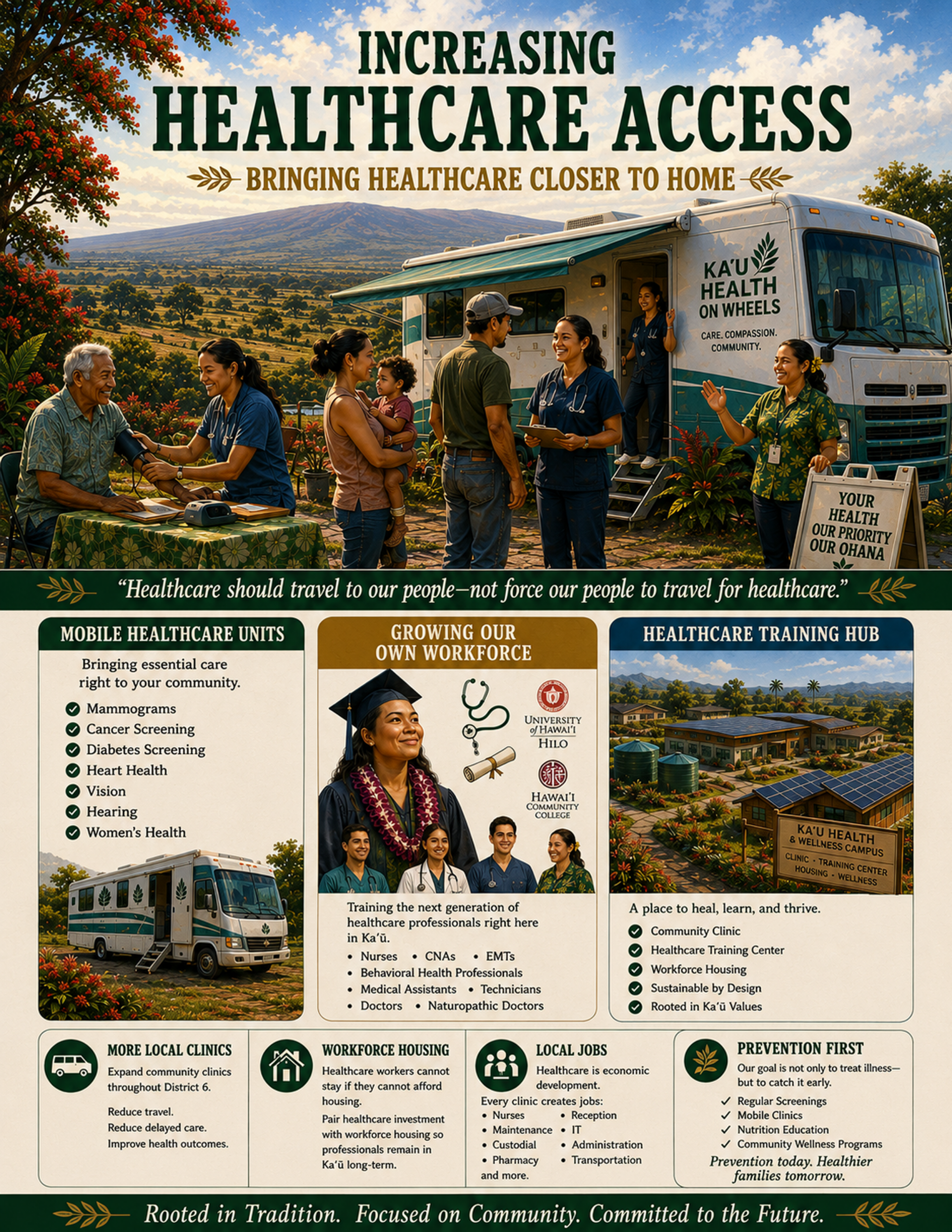
Zed believes that we can turn our greatest challenges into our greatest strengths. We can do that by building District 6 into a true rural healthcare hub: expanding local services, training the next generation of medical professionals, and creating career pathways that keep our people working right here at home. With a stronger healthcare workforce and a robust kūpuna care economy, our district can become one of the healthiest and most self-sufficient regions in Hawaiʻi.
Rural Resilience: Agriculture & Food Security
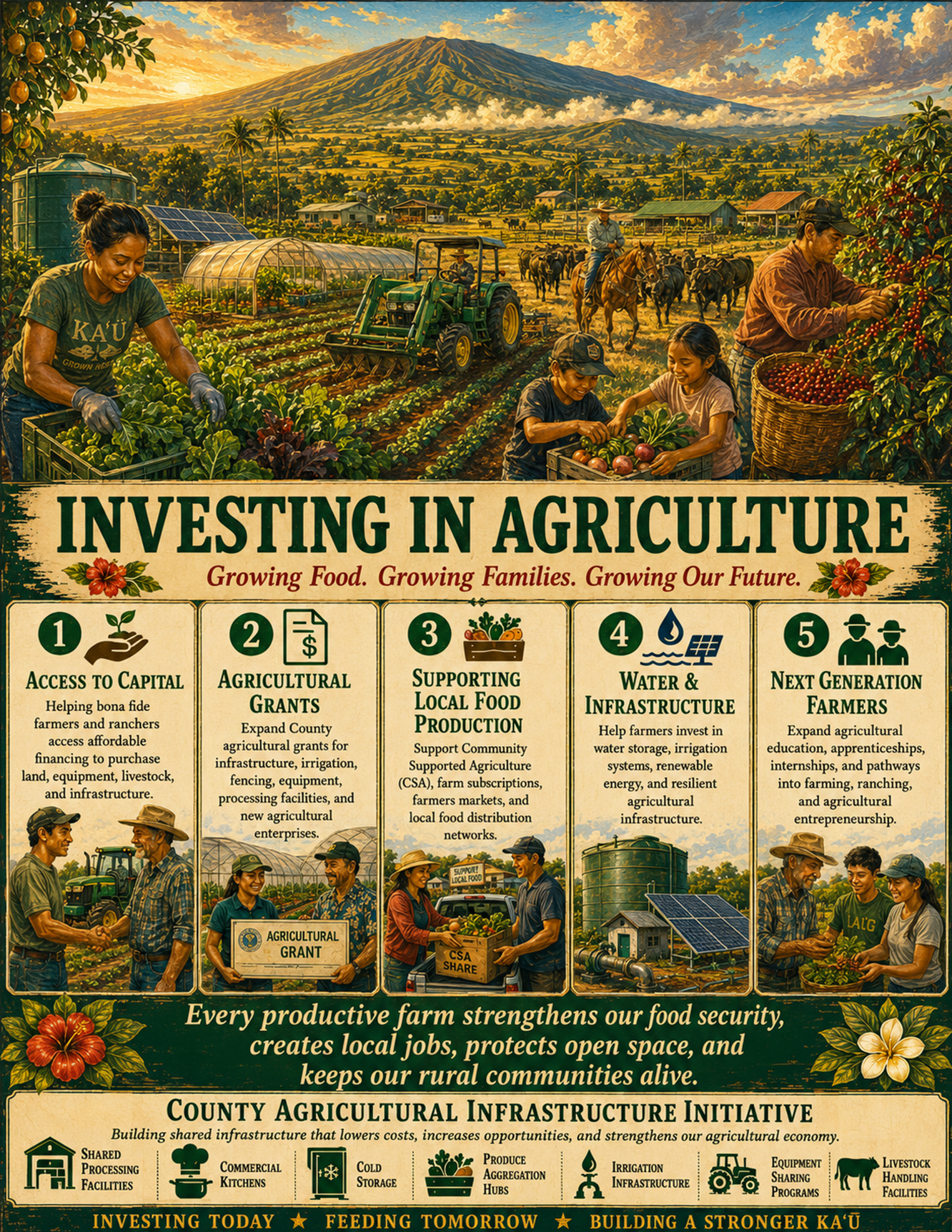
Zed believes District 6 should be one of the strongest agricultural regions in Hawaiʻi - the proverbial breadbasket of the state (or poi ʻumeke). We have the land, the technology, and the people to grow food, build local businesses, and create real careers rooted in the rural economy. By investing in water access, agricultural infrastructure, farmer and rancher support, and agricultural workforce development, we can strengthen our food security and ensure that our families will never go hungry again. District 6 can lead Hawaiʻi toward self-sufficiency.
Ending Rural Disparities: Transportation, Infrastructure, Energy & Cost of Living
Zed believes rural families should not pay more just because they live farther from town. Zed will fight to reduce the rural cost burden by improving transportation planning, strengthening infrastructure, and pursuing energy strategies that lower electric costs. He will also push for realistic and affordable solutions for cesspool conversion and wastewater compliance as well as rainwater catchment system maintenance in remote areas.
Ensuring Community Safety & Inclusivity
Zed believes District 6 should be a place where families feel safe, supported, and connected. That means protecting communities from crime and disorder, while also ensuring vulnerable residents are not isolated or ignored. Safety and inclusivity go together. A district that protects its people is a district that invests in its people. A community is only as strong as how it supports its most vulnerable. Families raising children or supporting members with disabilities -including intellectual and developmental disabilities (I/DD) - deserve more support—not less. And in rural districts, those challenges are often multiplied by distance, limited services, and lack of opportunity. Zed believes District 6 must lead in building inclusive programs and meaningful pathways for individuals with disabilities to thrive.

1. Rural Resilience: Healthcare & Kūpuna Care

It takes over 30 minutes to get to the nearest hospital from my home in Ocean View – an hour to the Kona Community Hospital. My aging parents often have to fly to Oʻahu for specialty care and they’re contemplating moving just to have access to healthcare. For generations the remoteness of our communities have torn apart families.  

District 6 has spent too long paying the price of distance. Families drive hours for appointments, kūpuna are forced to leave their communities to receive care, and rural residents too often face limited access to basic services that other parts of the island take for granted. That reality is not acceptable, and it does not have to be permanent.

I believe we can turn our greatest challenges into our greatest strengths. District 6 can become a place known not for being underserved, but for being prepared, self-sufficient, and ahead of the curve. That starts with building a true rural healthcare hub: expanding local services, training the next generation of medical professionals, and creating career pathways that keep our people working right here at home. It won’t happen overnight, but it’s the kind of critical infrastructure that needed to be prioritized for decades. 

The County has a role to play in this. While many healthcare services fall under state and federal systems, the County can still lead by coordinating partnerships, prioritizing infrastructure, supporting workforce housing, and using its influence to attract the right investments, programs, organizations, and people into our district.

Expanding Local Healthcare Access

Rural communities should not have to plan their lives around long drives to Kona or Hilo just to see a doctor. Zed supports expanding access to basic care and preventative services so families can get help early, instead of waiting until an issue becomes an emergency.

I will fight for:

  • Expanded access to clinics and rural healthcare facilities in Kaʻū, Ocean View, and South Kona

  • Increased availability of primary care, women’s health, and pediatric services

  • More consistent access to specialist services through rural outreach programs

  • Better coordination with healthcare providers to close gaps in coverage

Emergency Response and Rural Public Safety

In rural communities, minutes matter. District 6 needs stronger emergency response capacity, better coordination, and the resources to ensure residents are not left vulnerable simply because they live farther away.

I will prioritize:

  • Strengthening ambulance and paramedic capacity in rural regions

  • Improving emergency response coordination across Kaʻū and South Kona

  • Supporting infrastructure and facility needs that improve response time

  • Advocating for better coverage in isolated communities

Mental Health and Substance Abuse Recovery

Mental health care should not be treated as optional, and rural communities should not be left behind when it comes to addiction recovery services. Too many families are struggling in silence, and too many residents have to leave the district to access the support they need.

I will work to expand:

  • Rural mental health counseling access

  • Substance abuse recovery programs and outreach services

  • Community-based wellness programs that strengthen resilience

  • Partnerships that bring more providers into District 6

Building District 6 into a Healthcare Training and Career Hub

One of the biggest reasons rural healthcare fails is because rural communities can’t keep enough medical professionals. District 6 should not only recruit and house healthcare workers—it should produce them.

I believe District 6 can become a place where local residents train for stable, high-paying careers in healthcare without needing to leave home permanently. That means developing pathways for young people and working adults to enter medical professions, including careers that don’t require a decade of schooling.

I support:

  • Partnerships with schools, training programs, and universities to create local pipelines

  • Expanding training opportunities for EMTs, CNAs, medical assistants, and nurses

  • Supporting programs that bring clinical training and internships into rural communities

  • Building a healthcare workforce that reflects the people of District 6

Kūpuna Housing & Care

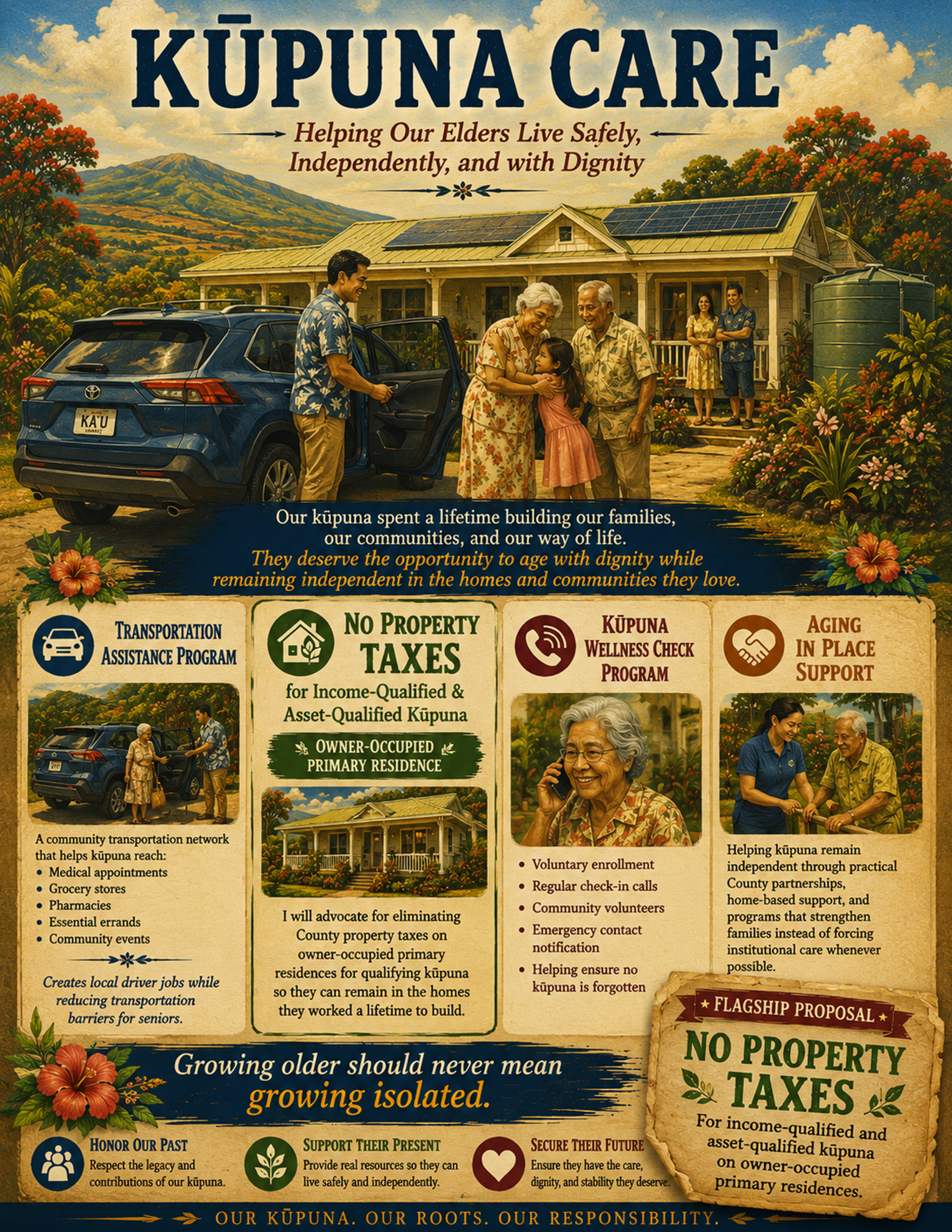
Our kūpuna deserve better than being forced to relocate away from their families simply because rural communities lack services. I believe we must build a stronger kūpuna care economy—one that supports local jobs while ensuring our elders can age with dignity, stability, and respect.

I will advocate for:

  • More affordable housing options designed specifically for kūpuna

  • Planning support for assisted living and long-term care solutions in rural areas

  • County coordination to expand senior support services

  • Increased caregiver support resources for families caring for kūpuna at home

  • Investments that allow kūpuna to age in place, close to family and community

A County Role in Healthcare Investment

The County may not directly operate hospitals, but it can play a major role in shaping the conditions that determine whether healthcare services expand or shrink.

I will push the County to use every tool available, including:

  • Strategic land use and planning support for healthcare facilities

  • Partnerships to bring funding and pilot programs into rural areas

  • Infrastructure priorities that make rural healthcare expansion realistic

  • Workforce housing strategies that help attract providers

District 6 has the potential to become one of the healthiest and most self-sufficient regions in Hawaiʻi. That will not happen by accident. It will take championing that treats healthcare as essential infrastructure and refuses to accept the idea that rural families deserve less.

2. Rural Resilience: Agriculture & Food Security

My father taught me the importance of using the ihe (spear) in times of war and trading it for an ʻōʻō (digging pole) in times of peace, so that no matter the time, I will always be prepared. My passion for advocacy cultivates my passion for mahiʻai and my struggle to exist as a mahiʻai now kindles the fire for my advocacy.

The State of Hawaiʻi has long-since known that it imports the vast majority of its food, has supply chain vulnerabilities that are unspoken crises, and a housing crisis that worsens our food insecurity – the state knows that the solution to these problems is in responsibly developing and bolstering the agricultural sector. But nothing ever happens.

I have a Master’s degree in agricultural science, many hours devoted to agribusiness planning – plans vetted by the foremost experts in their field- and yet, I have struggled to gain any kind of support from the state and counties to produce food for my community as a farmer. It’s clear that we need a champion.

I believe District 6 should be one of the strongest agricultural regions in Hawaiʻi—the proverbial breadbasket of the state (or poi ʻumeke). We have the land, the technology, and the people to grow food, build local businesses, and create real careers rooted in the rural economy.

For too long, Hawaiʻi has relied on imports for survival while local agricultural potential sits underutilized. That is not sustainable. It is expensive, it is risky, and it leaves our families vulnerable to supply chain disruptions and rising costs.

District 6 is positioned to change that. Agriculture is not just about farming. It is about food security, economic strength, cultural practice, and long-term survival. With the right investment and county leadership, District 6 can help lead Hawaiʻi toward self-sufficiency.

Supporting Farmers and Ranchers

Farmers and ranchers in District 6 are not asking for handouts—they are asking for a fair shot. They need a County government that understands the realities of rural production and works with them instead of creating obstacles.

I support policies and programs that:

  • Reduce barriers for farmers and ranchers trying to operate legally and sustainably

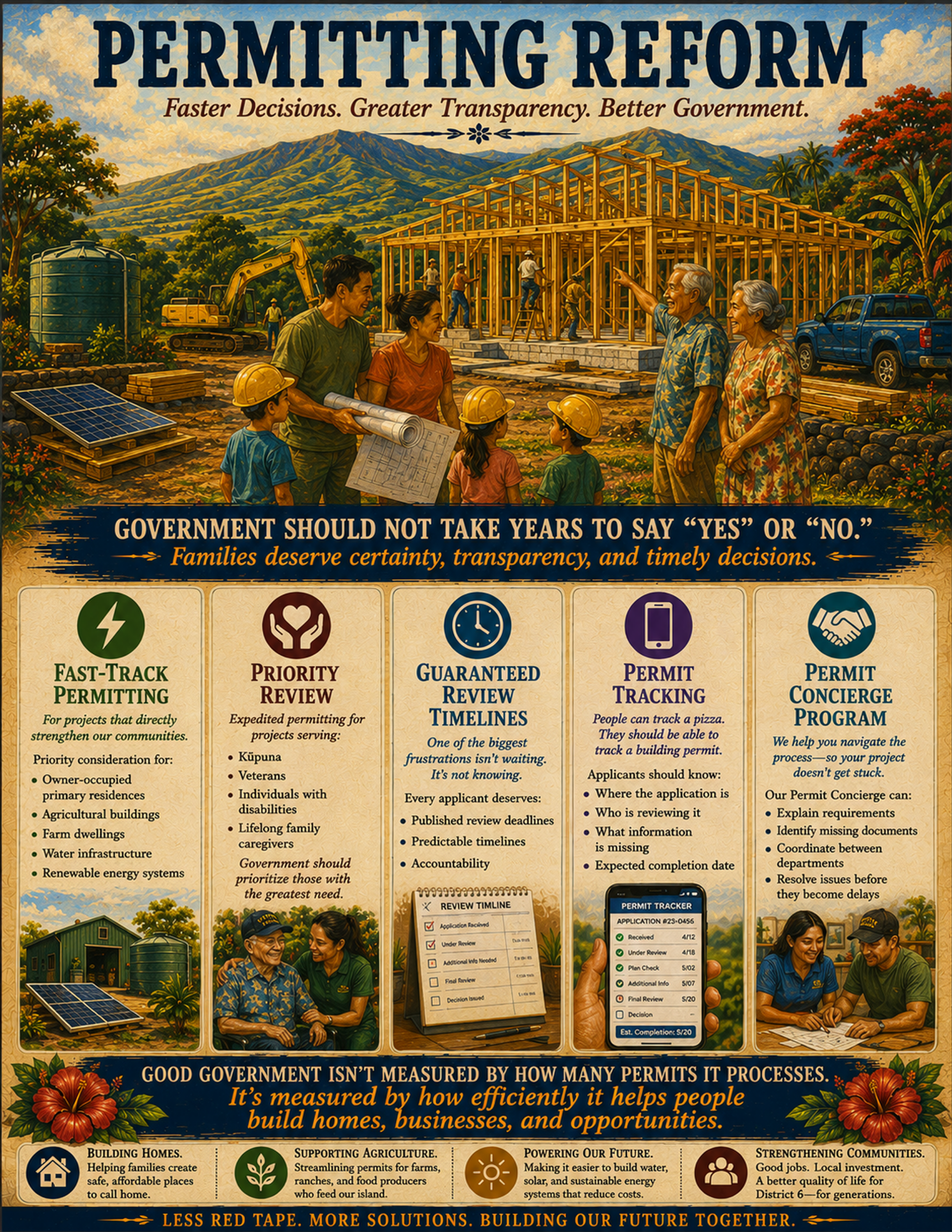
  • Improve permitting processes and reduce unnecessary delays

  • Support agricultural entrepreneurs, small producers, and multigenerational farm families

  • Expand access to county resources and technical support

  • Establish our farms and ranches as critical food infrastructure necessary for our survival 

Water Access and Agricultural Infrastructure

If Hawaiʻi wants food security, it must invest in agricultural infrastructure. That begins with water. Farmers cannot succeed without reliable access, storage, and distribution systems.

I will advocate for:

  • Water infrastructure investment and improved long-term planning

  • Support for irrigation development and water catchment capacity

  • Agricultural roads and access improvements that support rural production

  • County coordination that helps farmers navigate infrastructure challenges

Agricultural Workforce Development

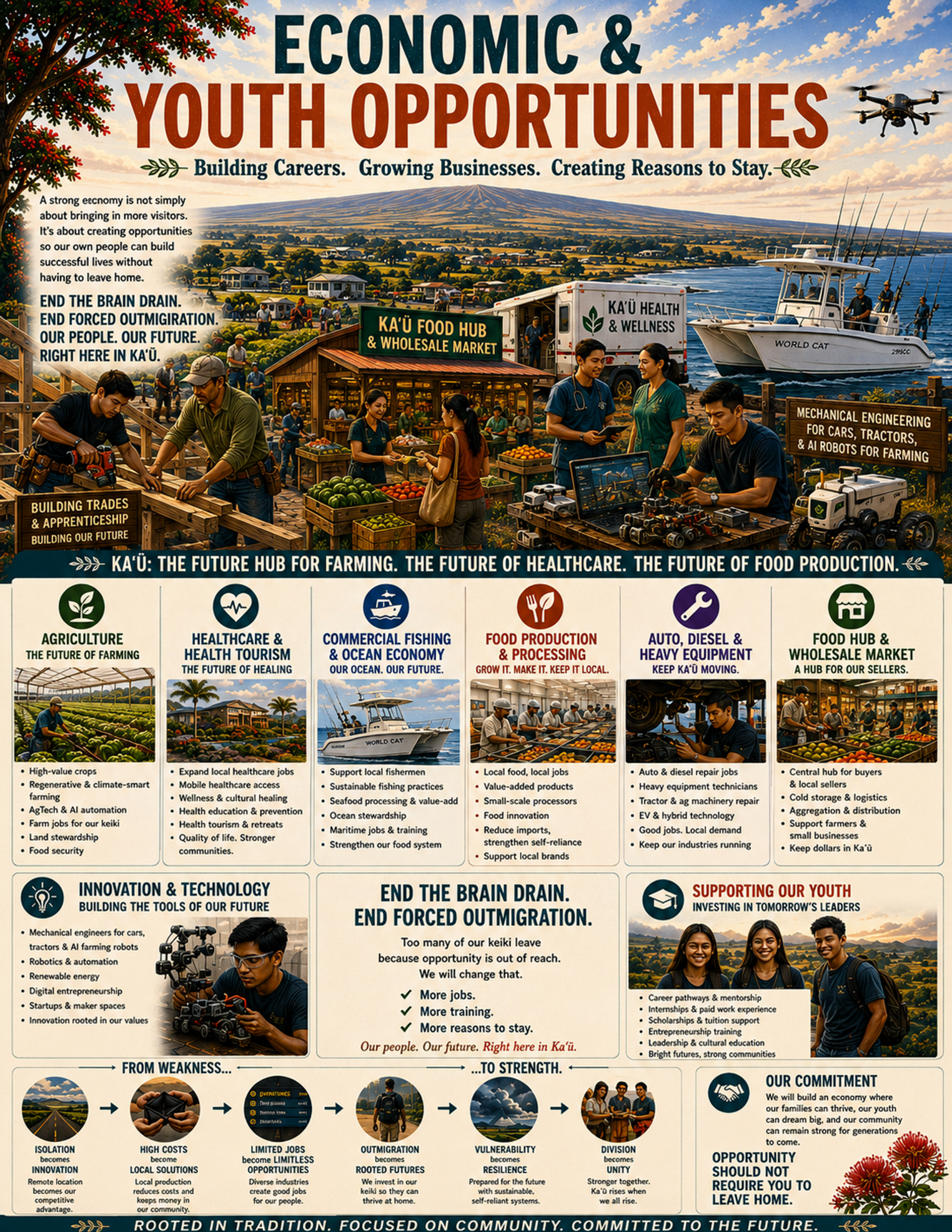
One of the greatest opportunities in District 6 is creating career pathways rooted in agriculture. Hawaiʻi needs a new generation of farmers, ranchers, agricultural technicians, and food system workers. The farmer of the future is also an engineer. 

I believe agricultural workforce development should be treated as economic development.

I support:

  • Training and apprenticeship pathways for local residents

  • Partnerships with schools and workforce programs that lead to real jobs

  • Career development that connects agriculture to technology, engineering, mechanics, processing, computer programming, AI development, and logistics

  • Programs that help young people stay in the district and build stable livelihoods

Building Local Food Systems

Growing food is only one part of the equation. Hawaiʻi needs stronger systems for processing, storage, distribution, and local sales. Without those systems, farmers are forced to rely on limited markets, expensive transportation, and unstable pricing.

I support building stronger local food systems by expanding:

  • Food processing and value-added production opportunities

  • Storage and distribution capacity in rural communities

  • Local markets and pathways to sell directly to residents

  • Partnerships that connect producers to schools, institutions, and local buyers

  • Culturally relevant and appropriate foods as critical food infrastructure

Protecting Agricultural Lands and Supporting Real Agriculture

District 6 has seen too many cases where “agriculture” is used as a label, while the real intent is development or speculation. That hurts real farmers, drives up land prices, and weakens the district’s long-term food-producing capacity.

I believe the County must do a better job protecting agricultural lands and ensuring agricultural zoning is used responsibly.

I will fight for:

  • Stronger protections against abuse of agricultural land use

  • Policies that prioritize real production, not loopholes

  • Planning strategies that preserve rural character while supporting economic growth

  • Responsible development that strengthens the district rather than displacing it

Tourism That Builds Other Industries

Tourism is part of Hawaiʻi’s reality, but it should not be the only pillar holding up our economy. Historically, tourism has faced disruptions that have forced many families out of business and out of home. I support tourism that is responsible, balanced, and respectful—but I also believe tourism must be leveraged to strengthen the industries that should truly sustain our communities.

District 6 has an opportunity to build a model where tourism helps fund and support:

  • agriculture infrastructure

  • local food production

  • workforce development

  • healthcare expansion

  • rural community stability

Tourism should not replace our economy. It should help build it.

Food Security as a County Priority

Food security is not something the County can ignore. County leadership can influence land use decisions, infrastructure investments, economic development strategies, and the overall viability of farming across Hawaiʻi Island.

I will push for county-level planning that treats agriculture as essential, including:

  • long-term agricultural development strategies for District 6

  • infrastructure coordination that supports production

  • stronger local food resilience planning

  • policies that make it easier for farmers to succeed

District 6 can become a place where agriculture is not treated as a side issue, but as a major economic engine and a foundation for community strength. I believe Hawaiʻi’s future depends on our ability to feed ourselves, and District 6 can help lead the way.

3. Ending Rural Disparities: Transportation, Infrastructure, Energy & Cost of Living

For many residents of District 6, rural life comes with a price tag that people in Kona and Hilo rarely have to think about. Long drives, limited services, and aging infrastructure create a constant burden on working families. The further south you live, the more you pay—not because you chose luxury, but because you chose to live at home.

I believe rural communities should not be penalized for their geography. District 6 residents deserve the same level of investment, planning, and basic support as any other part of Hawaiʻi Island. Ending rural disparities is not about asking for special treatment. It is about fairness, and it is about government doing its job.

This is especially true for communities like Ocean View, Miloliʻi, Waiʻōhinu, Nā‘ālehu, and the southernmost parts of Kaʻū, where residents often travel long distances for healthcare, groceries, employment, and government services. That distance affects every part of life, and it drives up the cost of living in ways that are often overlooked.

I will fight for policies that reduce the rural cost burden, strengthen infrastructure, and improve access across the district.


Transportation and the Cost of Distance

For District 6 residents, transportation is about survival. Many families drive to Kona or Hilo daily for work, school, medical appointments, and basic services. Those commutes are long, expensive, and exhausting.

Long-distance commuting comes with real costs:

  • high fuel expenses

  • increased wear and tear on vehicles

  • constant repair bills

  • safety concerns on poorly maintained roads

  • limited public transportation options

I believe the County must stop treating rural transportation as an afterthought and begin planning as if rural families matter just as much as urban residents.

I will prioritize:

  • improving road maintenance in rural corridors and high-need communities

  • advocating for transportation planning that reflects real rural commuting patterns

  • strengthening safety improvements in remote areas

  • supporting practical solutions that reduce the burden of long commutes

  • exploring the viability of air and ocean transportation infrastructure with minimal negative environmental impact 

District 6 cannot thrive if families are spending a major portion of their income just getting to work.


Infrastructure that Matches Rural Reality

Many District 6 communities operate with limited infrastructure and inconsistent access to basic services. In rural areas, infrastructure has significant direct impact on health, safety, and quality of life.

I believe District 6 deserves infrastructure planning that reflects what rural communities actually need, including:

  • roads and access routes

  • reliable utilities

  • broadband and communication infrastructure

  • emergency response support

  • water and wastewater solutions

The County must take a stronger role in coordinating infrastructure development, ensuring that rural communities are not permanently stuck in a cycle of being underserved.


Energy Burdens and the Cost of Power

Hawaiʻi has some of the highest electricity rates in the nation—often more than three times the national average. For District 6 residents, that burden is even worse because rural households face limited options.

Many families are forced to live off-grid. Others are connected to the grid but still pay extreme monthly costs. Off-grid systems require major upfront investment and long-term maintenance, and when something breaks, it is rarely cheap to repair (in that same vein, the same goes for plumbing).

Energy costs affect everything:

  • household stability

  • small business survival

  • food costs (refrigeration and storage)

  • the ability to run medical devices or home care equipment

  • the long-term feasibility of living in rural Hawaiʻi

I believe the County must treat energy affordability as a serious economic issue, not just an environmental talking point.

I will fight for:

  • energy strategies that lower costs for residents

  • infrastructure planning that improves grid stability in rural areas

  • renewable energy development that benefits local communities, not just outside investors

  • stronger support for energy resiliency options for rural households 

  • energy justice and infrastructure equity – addressing environmental racism/injustice, sacrifice zones, and disproportional impacts of locally undesirable land uses (LULUs)

District 6 should be a model for rural energy resilience, not a district where families are forced to choose between power and groceries.


Wastewater, Septic Systems, and Cesspool Conversion (Act 125)

Many rural residents rely on cesspools and septic systems because sewer infrastructure simply does not exist in large parts of District 6. Under Act 125, the State of Hawaiʻi has banned cesspools and requires their replacement by 2050. While protecting water quality is important, the reality is that cesspool conversion can be incredibly expensive for rural homeowners—especially when sewer connection is not possible.

In many cases, families are being asked to spend tens of thousands of dollars to comply with a mandate they did not create, in communities where the infrastructure alternatives simply are not available. It’s not a matter of negotiating whether the practice of cesspools should end – it should – it’s a matter of putting our resources together so they can end quicker – for our greater benefit. 

I believe this issue must be addressed with fairness, practicality, and urgency. Rural families should not be financially crushed simply because they live in areas that lack sewer infrastructure.

I will advocate for:

  • stronger county-level support and coordination for rural cesspool conversion

  • improved access to funding assistance, incentives, and financing options

  • realistic planning for septic conversion in areas where sewer connection is not feasible

  • policies that recognize rural infrastructure limitations instead of ignoring them

Environmental responsibility matters, but the burden must not fall entirely on working families.


A District 6 Strategy to Reduce the Rural Cost Burden

Rural disparities are not isolated problems. Transportation costs affect job access. Energy costs affect business viability. Infrastructure gaps affect healthcare access. All of it compounds into a higher cost of living for rural families.

I believe the County must take an interdisciplinary approach to solving rural disparities by coordinating:

  • transportation planning

  • infrastructure development

  • energy strategies

  • rural housing solutions

  • economic development priorities

District 6 deserves a County government that plans with rural reality in mind, not one that assumes every resident lives five minutes from a hospital, grocery store, or public utility connection.

I will fight to ensure rural communities are prioritized in County decision-making—not just in words, but in budgets, planning, and results. Hana Now! Stop walaʻau. 

4. Ensuring Community Safety & Inclusivity

There’s not a day that goes by where I don’t hear about some crime or an unaddressed hazard in one of our neighborhoods. As a resident, I’m deeply concerned and as a parent worry greatly. We need to do better. 

believe every resident of District 6 deserves to feel safe in their home, safe in their neighborhood, and supported in their community. Public safety isn’t the sole burden of our law enforcement officers and their capacity to serve and protect—it’s about community support for prevention, accountability, our own community strength, and making sure vulnerable populations are not left behind.

District 6 is one of the largest and most rural districts in the state. That remoteness creates unique challenges: limited law enforcement presence, long emergency response times, and fewer resources for families who need support. I believe we must take a serious, proactive approach to safety by strengthening both law enforcement capacity and community-based support systems.

At the same time, I believe safety also means inclusion. I have two beautiful children on the autism spectrum and I’m thankful – beyond words – that I have them in my life. I wouldn’t be the kind of good person that I am today, if not for them. Parents with children who have I/DD know exactly what I mean. You also know the disparities we endure on their behalf because society isn’t quite ready just yet to fully embrace their uniqueness – but we’re getting there. 

District 6 has many families raising children and caring for loved ones with disabilities, including intellectual and developmental disabilities (I/DD). These families are some of the strongest and most resilient people in our communities, but they are also among the most underserved. The reality is that the disabled/differently abled community faces barriers almost everywhere—healthcare access, transportation, education support, employment, housing, recreation, and basic inclusion.

In rural and remote communities, those barriers are even heavier.

I believe this is not just a social issue. It is a community issue. It is an economic issue. It is a quality-of-life issue. And it is a moral issue. The way a society treats its most vulnerable people says everything about its leadership and priorities.

District 6 can and should become a place where individuals with I/DD are not pushed to the margins, but are supported, valued, and given real pathways to live meaningful and productive lives. Every community should be. Let’s lead the way. 

Strengthening Public Safety and Reducing Crime

I believe residents deserve a stronger public safety presence across Kaʻū and South Kona. Rural communities should not feel abandoned or unprotected simply because they are farther from urban centers.

I will fight for:

  • stronger police presence and coverage in rural communities

  • improved response time capacity through better coordination and resource allocation

  • county investment in crime prevention strategies that actually work

  • support for enforcement efforts that target repeat offenders and chronic crime activity

I believe law enforcement must be supported, well-trained, and properly resourced, so that they may remain accountable to the communities they serve. 

Reducing Recidivism and Building Long-Term Solutions

Crime reduction cannot rely only on arrests. District 6 needs long-term strategies that reduce repeat offenses and give people pathways to rebuild their lives.

I support:

  • rehabilitation programs that reduce recidivism

  • workforce development and job training opportunities for at-risk individuals

  • partnerships with nonprofits and community organizations that address root causes

  • mental health and substance abuse support as part of public safety strategy

A safer district requires both enforcement and prevention.

Supporting Community-Based Safety Groups

District 6 has strong communities filled with residents who step up when government systems fall short. Volunteer organizations and neighborhood groups are often the first line of defense in rural areas, but many operate with limited funding and limited resources.

I believe the County must strengthen and support these groups.

I will advocate for:

  • increased support and training for volunteer fire departments

  • greater investment in emergency preparedness and disaster readiness

  • stronger neighborhood watch and community safety programs

  • county partnerships that empower local groups instead of leaving them on their own

In rural communities, local capacity is everything.

Strengthening Rural Services and Access

Many families in District 6 have limited access to services that urban areas take for granted. Parents and caregivers often spend countless hours navigating complicated systems, traveling long distances for appointments, and fighting to secure support that should already be available.

I believe rural communities need stronger local access to:

  • therapy and support services

  • case management and family resources

  • behavioral health programs

  • inclusive recreation opportunities

  • caregiver support networks

I will work to build partnerships and push county coordination to help expand access to services across Kaʻū and South Kona, especially in communities that have been historically overlooked.


Supporting Families In and Out of School

School-aged children with I/DD often require additional support, specialized services, and consistent resources. Many families also struggle when services are limited or inconsistent, and when programs do not reflect the real needs of rural communities.

I believe families should not have to fight endlessly just to secure basic support for their children.

I will advocate for:

  • stronger coordination between schools, families, and service providers

  • increased rural accessibility to programs that support I/DD youth

  • expanded resources for families who need support outside of school hours

  • better community-based services that reduce the burden on parents and caregivers


Transition Support for Youth Aging Out of School

One of the biggest gaps in the I/DD system happens when students reach adulthood. Many families describe this as a cliff. Once a young person ages out of school-based programs, services often shrink, opportunities disappear, and families are left without meaningful support.

I believe District 6 needs better transition planning for young adults with I/DD so that adulthood does not become a dead end. Let’s be that special place for them.

I will fight for:

  • stronger transition programs that prepare youth for adulthood

  • life skills and independence support services

  • workforce training opportunities that match real ability and potential

  • pathways into meaningful community roles and stable employment

  • the dream of Infinite Worlds, where our community looks after and cares for each other like one big family. 


Meaningful Employment and Economic Opportunity

I believe employment is one of the most important areas where the County can step up. Too many adults with I/DD want to work, want to contribute, and want to earn a paycheck—but the system often offers limited options, minimal job development, and little long-term support.

Meaningful employment is not charity. It is dignity. It is inclusion. It is independence.

I support:

  • building job training programs designed for individuals with I/DD

  • creating partnerships with local businesses and nonprofits to expand employment opportunities

  • supporting social enterprises and programs that provide stable, supportive work environments

  • encouraging county-level programs that expand employment opportunities within public services and contracts

District 6 has the potential to become a model for how rural communities create inclusive employment pathways.


Building a Stronger Support Network for Caregivers

Families caring for individuals with I/DD often carry enormous responsibilities. Many parents and caregivers are stretched thin financially, emotionally, and physically. In rural communities, this pressure can be even more intense because services are limited and support networks may be smaller.

I believe caregivers deserve real support and recognition, not just praise.

I will work to expand:

  • caregiver resource networks

  • community partnerships that support respite care and family relief

  • increased access to rural support programs

  • advocacy for improved service delivery where rural families are currently underserved


Building a District Where Everyone Belongs

District 6 should be a place where every person feels valued and included. Zed believes that community inclusion must be built intentionally through programs, planning, and leadership that recognizes I/DD residents as full members of our district.

That means:

  • inclusive community programs and public events

  • accessible facilities and recreation opportunities

  • community education and outreach that builds understanding and respect

  • leadership that makes inclusion part of the district’s identity

I believe District 6 can lead Hawaiʻi in building a more inclusive and supportive future—not only for individuals with I/DD, but for every family that loves and cares for them.